
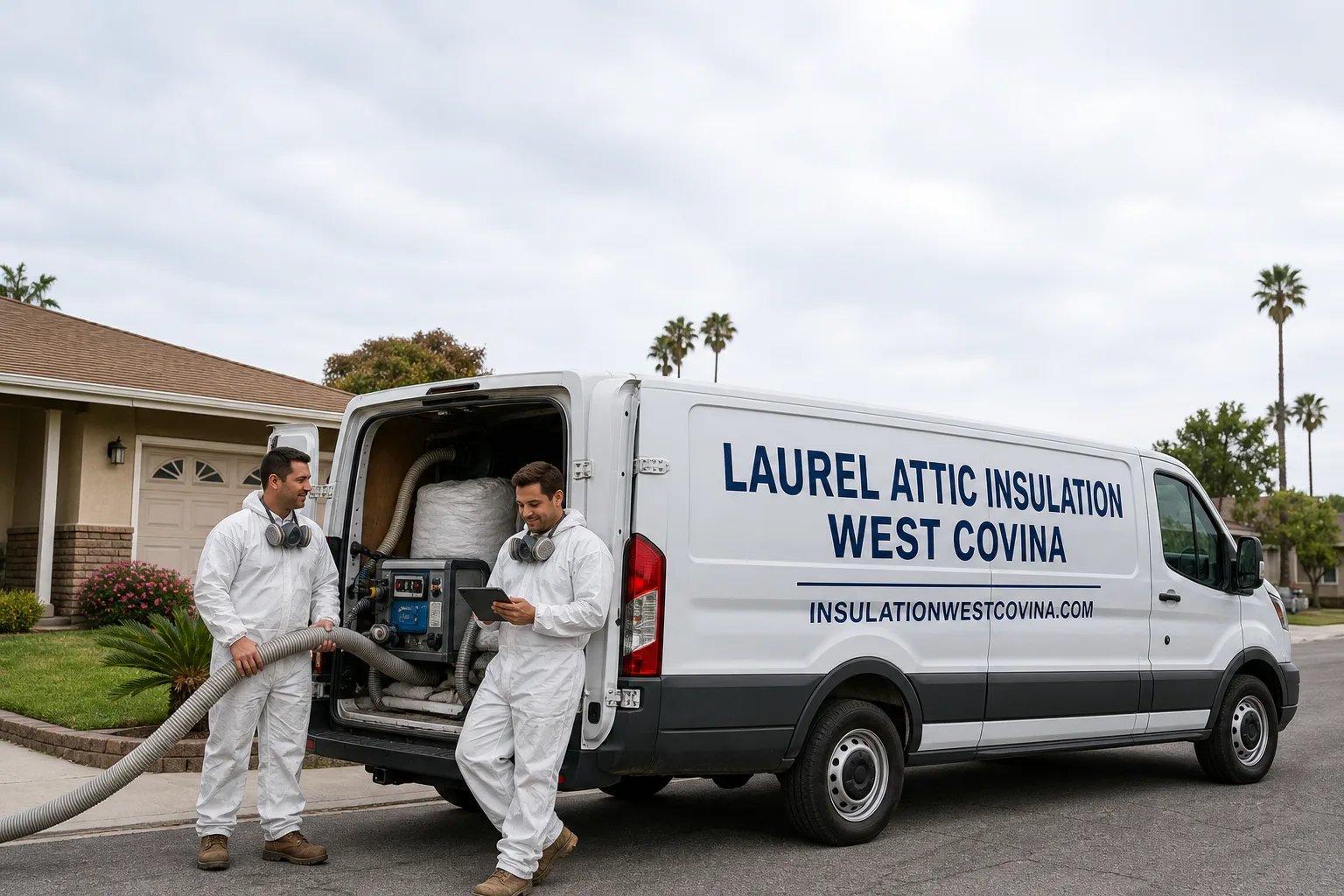
Fast, Reliable Spray Foam Insulation Across South Whittier
Spray foam insulation in South Whittier typically runs $1,800 to $4,600 for an attic job, depending on square footage, foam type, and whether we’re air-sealing the top plates. Most jobs are done in a single day. If you’re in a post-war ranch off Colima Road or a 1980s two-story near La Mirada Boulevard, call (831) 531-5104 and we’ll give you a written price before anything starts.
Our crews know South Whittier’s housing stock. We’re familiar with the stucco ranches along Telegraph Road, the track homes near Pioneer Boulevard, and the split-levels tucked around the 90605 zip code. When you book with Laurel Attic Insulation, you get a live arrival time, not a four-hour window. And we show up with material matched to your house, not whatever’s left on the truck.
Why Laurel Attic Insulation West Covina Is South Whittier’s Preferred Spray Foam Insulation Company
South Whittier homeowners tend to ask sharp questions. They’ve lived in homes built between 1950 and 1970 long enough to know when an upgrade actually pays off. We answer those questions with specifics. Founded in 2003 as part of the Relay Home Co. family, Laurel Attic Insulation is run today by Chase Whitaker, who insists every job in South Whittier gets the same treatment: a written price first, a live-tracked technician second, and photo documentation of the work third.
That’s the Relay Visibility Guarantee, and it’s not optional for us. You’ll see before-and-after photos of your attic. You’ll get a digital invoice you can pay from your phone. And if anything isn’t right, the 365-Day Done Right Promise means we fix it, in writing, at no charge. Our office is staffed 24/7. You call, a person answers. No voicemail maze.
We’ve worked on enough South Whittier ranches to know what’s behind the stucco. Chase and the team have seen original batt insulation slumped to the top plate, old rock wool compacted under roof valleys, and second-story additions from the Reagan era that never got proper insulation at all. That local pattern recognition means our estimates are accurate and our crews work fast.
Spray Foam Attic Insulation in South Whittier
Spray foam attic insulation in a South Whittier home is the single highest-impact upgrade for houses built between 1950 and 1970. Those ranches often have 3 to 4 inches of original batt insulation that has settled below the top plate, which leaves a continuous heat strip around the attic perimeter. Open-cell spray foam kills that problem in one pass because it expands into the gap, seals it, and adds insulation value at the same time. A typical open-cell attic job for a 1,100-square-foot South Whittier ranch runs $2,200 to $3,800. Closed-cell costs more, usually $3,500 to $5,500 for the same footprint, because it adds structural rigidity and a vapor barrier.
Air Sealing the Top Plates
The top plate is where your wall framing meets the attic floor. In South Whittier homes, this seam is almost never sealed. Conditioned air leaks out of the living space and pulls hot attic air in. Spray foam applied along the top plates stops that exchange. We do this on every attic job, and it’s built into the price.
Valleys and Bare Decking
Roof valleys concentrate airflow and heat in ways flat decking doesn’t. In older South Whittier attics, the original rock wool has often compacted or shifted away from valleys entirely. Spray foam covers those bare spots completely, including the irregular geometry that batts can’t handle.
Spray Foam Wall Insulation in South Whittier
Spray foam wall insulation in South Whittier works best when you have empty wall cavities. That’s common in the 1950s stucco ranches, where builders sometimes skipped wall insulation entirely. Open-cell spray foam injected into those stud bays runs $1.50 to $2.50 per square foot of wall area. For a typical single-story home with 1,000 square feet of exterior wall, that’s roughly $3,000 to $5,000 before any drywall patching. It fills the cavity completely, seals every gap around electrical boxes, and stops the drafts that make rooms near exterior walls feel 10 degrees off.
Two-Story 1980s Additions
We hear it constantly from South Whittier homeowners: the upstairs is always hotter. Many 1980s additions were built with fiberglass batts stuffed inconsistently, if at all. The wall cavities between the original structure and the addition are often irregular. Spray foam conforms to those odd shapes without leaving voids. Closed-cell works particularly well here because its higher R-value per inch matters when wall cavities are shallow.
Knob-and-Tube Considerations
Some South Whittier homes from the late 1940s and early 1950s still have knob-and-tube wiring in wall cavities. We inspect before we foam. You cannot spray foam directly over energized knob-and-tube. In most cases, the wiring should be evaluated by an electrician first, then we can proceed safely with an approved approach.
Trusted Brands We Service in South Whittier
We work with materials from Icynene, Demilec, and Owens Corning, among others. For South Whittier’s inland heat pattern, we typically recommend open-cell Icynene for attics and closed-cell Demilec for walls or roof decks that need a vapor barrier. Each foam has a specific use case, and we’ll tell you which one fits your house. We keep stock ready for South Whittier jobs, so scheduling stays tight and there’s no second trip for materials. If you’re curious about the difference between open-cell and closed-cell for your specific roof pitch, the answer is one phone call away: (831) 531-5104.
For a deeper look at how foam compares to other insulation methods, see our Spray Foam Insulation service page.
Common Spray Foam Insulation Problems We See in South Whittier Homes
- Settled rock wool under roof valleys. Original blown-in rock wool from the 1950s and 1960s compacts over decades. In South Whittier attics, we routinely find it has slumped to less than half its original R-value, leaving bare decking under valleys where radiant heat pours straight into living spaces.
- Unsealed top plates and bypasses. South Whittier ranches almost never have sealed top plates. Attic bypasses around recessed lights, plumbing vents, and wall framing let conditioned air escape. If you spray foam without sealing these first, the foam underperforms and you’ve wasted part of the investment.
- DIY batts over unvented soffits. Homeowners sometimes add fiberglass batts over soffit vents to “beef up” insulation. In South Whittier’s climate, that traps moisture against the roof decking. Then you get condensation, mold, and decking rot. Spray foam applied correctly works with the ventilation system, not against it.
- Inconsistent second-story additions. The 1980s additions common in South Whittier were often insulated by whoever built them, with whatever was cheap. Upstairs rooms bake in July. Foam injection into those wall cavities fixes the problem permanently instead of chasing it with portable AC units.
Pricing for Spray Foam Insulation in South Whittier, CA
Here’s what South Whittier homeowners should expect to pay. Open-cell attic spray foam on a 1,000 to 1,500 square foot ranch runs $2,200 to $4,200. Closed-cell attic foam runs $3,500 to $6,000 for the same footprint. Wall cavity injection runs $3,000 to $5,000 for a typical single-story home. Rim joist spray foam, a smaller job, runs $800 to $1,600. Garage ceiling spray foam runs $900 to $2,000. The main cost drivers are square footage, foam depth, and access. If your attic has tight clearance or excessive debris, that adds labor time. We give you a written price before work starts, and that price doesn’t change at the door. Call (831) 531-5104 for a free estimate. We’ll measure, we’ll walk you through the options, and you’ll have the number in hand.
Deeper detail on local service areas is on our South Whittier page.
We Also Serve Cities Near South Whittier
Our crews cover the San Gabriel Valley and the surrounding area. In addition to South Whittier, we regularly work in West Covina, El Monte, La Puente, and Monterey Park. If you’re just across the city line, the same pricing and the same written guarantee apply. Dispatch is coordinated from the brand’s Los Angeles office, and crews are stationed to reach South Whittier quickly.
Serving South Whittier, CA - Our Local Coverage Area
We’re based in the South Whittier area and know this community well. Use the map below to see our service coverage - if you’re nearby, we can almost certainly help.
FAQs About Spray Foam Insulation in South Whittier
Because the existing insulation in most South Whittier ranches is original to the house and has failed. Batt insulation from the 1950s and 1960s settles below the top plate, leaving an uninsulated strip around the entire attic perimeter. Rock wool compacts. Neither material air-seals. Spray foam fills the gaps, seals the top plates, and delivers a continuous thermal barrier that old insulation simply cannot provide. If your attic still has original insulation, you’re losing conditioned air every hour of every day. Call (831) 531-5104 for an honest assessment.
In most cases, no, not until the wiring is addressed. Knob-and-tube wiring was designed to dissipate heat into open air. Encasing it in spray foam can cause overheating. If we find knob-and-tube in your South Whittier attic, we’ll stop the estimate and recommend an electrician evaluate it first. Once the wiring is updated or decommissioned, we can proceed safely. We will not compromise a fire safety issue to sell a job.
Extremely well. South Whittier sees summer afternoons in the 90s and nights that drop 25 to 30 degrees. That’s a wide diurnal swing, and it puts real strain on your HVAC system. Spray foam’s air-sealing properties stop the constant exchange of hot and cool air. Once sealed, your cooling system doesn’t fight the attic all afternoon, and your heating doesn’t fight the night chill. The result is a more stable indoor temperature with less equipment runtime.
It depends. If the rock wool has compacted or shifted, we remove it before spraying so the foam can bond directly to the decking and top plates. Spraying over loose, settled material creates an uneven substrate and prevents proper adhesion. In some cases, we can spray over rock wool that remains intact, but most South Whittier homes we see need removal first. Either way, you’ll know before we start, and it’s in the written estimate.
Yes. That’s one of the most common problems we solve. Second-story additions from the 1980s were often built with minimal or inconsistent insulation. The wall cavities and the floor joists between stories are rarely sealed. Spray foam injected into those wall cavities, combined with sealing the rim joists, typically drops the upstairs temperature by 8 to 12 degrees in summer. We sprayed a 1958 stucco ranch near the corner of Calmada Ave and Mulberry Dr where the original rock wool had slumped to bare decking under a valley. Our crew air-sealed the top plates and applied 5.5 inches of open-cell spray foam, then re-sealed the attic hatch. The homeowner’s July cooling runtime dropped by nearly a third.
Written by Chase Whitaker, Owner at Laurel Attic Insulation West Covina, serving South Whittier and the surrounding area.