
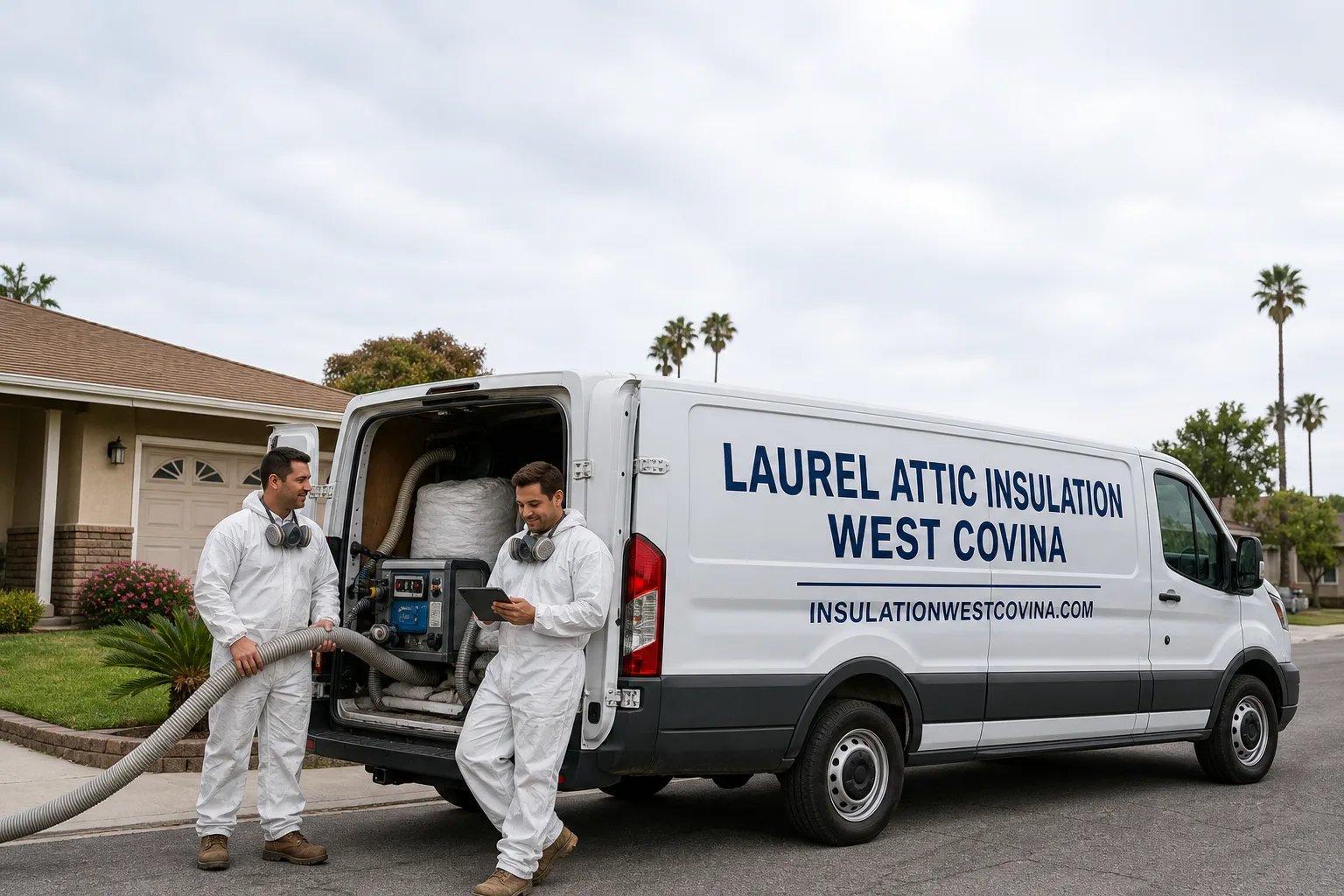
How Much Does Radiant Barrier Installation Cost in West Covina?
Radiant barrier installation in West Covina typically costs $1,450 to $3,800 for an average home, with most homeowners paying about $2,400. The price breaks down to roughly $0.90 to $1.60 per square foot for professional installation, including materials and labor. For a typical 1,800-square-foot attic here in the San Gabriel Valley, you’re looking at a one-day job in most cases.
Keep in mind that West Covina’s climate makes radiant barriers especially effective here. With summer temperatures regularly hitting the mid-90s and attic spaces climbing to 140 degrees or higher, a properly installed radiant barrier can cut attic heat gain by up to 20 degrees. That translates to real savings on cooling bills during those long San Gabriel Valley summers.
Key Takeaways: Radiant Barrier Cost in West Covina
- Average installed cost: $2,400 (range: $1,450 – $3,800)
- Per-square-foot cost: $0.90 – $1.60, materials and labor included
- Most installations finish in 4 – 8 hours
- Typical payback period in West Covina’s climate: 3 – 6 years on cooling savings alone
- Single-sided foil barriers run $0.35 – $0.55/sq ft for materials only
- Double-sided foil runs $0.50 – $0.75/sq ft for materials only
Radiant Barrier Installation Cost Breakdown (2026)
Here’s what you should expect to pay for radiant barrier installation in West Covina right now. These numbers reflect what we see on actual jobs in this market, not national averages that don’t account for Southern California labor rates and attic conditions.
| Cost Component | Typical Range | Notes |
|---|---|---|
| Single-sided foil radiant barrier (materials) | $0.35 – $0.55 per sq ft | Reflective surface faces the attic airspace |
| Double-sided foil radiant barrier (materials) | $0.50 – $0.75 per sq ft | Used when the barrier is exposed to dust or needs additional tear resistance |
| Labor (West Covina market) | $0.55 – $0.85 per sq ft | Includes attic prep, stapling, sealing seams, and cleanup |
| Attic prep and cleaning | $150 – $400 | Removing old insulation debris, checking for moisture issues |
| Sealing and tape | $40 – $120 | Foil tape for seams and edges; included in most quotes |
| Full install (average 1,800 sq ft attic) | $1,450 – $3,800 | All-in price, materials and labor |
Several things push that number up or down. Attics with steep rooflines, low clearance, or a lot of angles take longer to install properly. If your attic still has old fiberglass batts that have settled or been disturbed by rodents, you may need radiant barrier installation after insulation removal, which adds to the total. Homes in the older neighborhoods of West Covina, like the tracts off Merced Avenue or near Cameron Park, often have tighter attic framing that slows the job down compared to newer construction in areas like South Hills or the developments east of Azusa Avenue.
What Affects Radiant Barrier Installation Pricing in West Covina
Radiant barrier costs don’t exist in a vacuum. Here’s what actually moves the needle on your quote.
- Attic square footage and roofline complexity. A simple gable roof with a wide-open attic is the cheapest to do. Hips, valleys, dormers, and complex framing add labor hours. We see this all the time in West Covina: the custom homes off East Cortez Street with multiple roof angles cost more per square foot than the straightforward tract homes near West Covina High School.
- Single-sided vs. double-sided foil. Single-sided works fine for most West Covina attics because the barrier faces the airspace and dust accumulation is minimal. Double-sided makes sense if you plan to store items in the attic or if there’s visible dust from old insulation. It’s about $0.15 – $0.20 more per square foot in materials.
- Existing attic condition. If there’s water staining, rodent damage, or old insulation that has compressed down to nothing, that has to be addressed first. We’ve done radiant barrier installs in West Covina where the prep work doubled the total because the attic needed significant cleanup. Discovery is part of the honest quote process.
- Seasonal demand. Summer is peak season for radiant barrier installation in West Covina because that’s when people feel the heat. Scheduling in the fall or winter can sometimes mean faster availability, though pricing stays consistent year-round with reputable contractors.
- Access and attic height. Some West Covina attics, especially in homes built before 1970, have only 3 to 4 feet of clearance at the peak. Technicians work on their knees the entire time. Low attic access hatches in hallways and closets add time to bring materials up.
- Whether you bundle with insulation work. If you’re adding or replacing attic insulation at the same time, the per-square-foot cost of the radiant barrier portion often drops slightly because the crew is already in the attic with equipment staged. The Labor is the shared cost, not the materials.
Is Radiant Barrier Installation Worth It in West Covina?
For most West Covina homeowners, yes. The math is straightforward: a radiant barrier reduces attic temperatures by 20 to 30 degrees in the summer, which means your air conditioner doesn’t work as hard to keep the living space at 75 degrees when it’s 95 outside. The Department of Energy confirms that radiant barriers can reduce cooling costs by 5 to 10 percent in hot climates, and West Covina qualifies: we get roughly 40 to 60 days each year where the temperature exceeds 90 degrees.
Let’s put that in dollars. If your summer electric bill runs $250 a month and roughly half of that is cooling, a 10 percent cooling reduction saves you about $12 to $15 per month during the cooling season. Over a six-month cooling season, that’s $72 to $90 per year. On a $2,400 install, the payback takes longer than the national marketing claims suggest. But here’s what the national numbers miss: West Covina homes built in the 1950s and 1960s with original ductwork lose a lot of conditioned air through the attic, and a radiant barrier reduces the attic’s contribution to that problem. Every degree the attic drops is a degree your ductwork doesn’t fight.
There’s also a comfort factor that doesn’t show up in a payback calculator. The bedrooms on the west side of a home bake in the afternoon sun. A radiant barrier reduces that unevenness noticeably, especially in neighborhoods where homes sit close together and cross-ventilation is poor, like parts of the Woodside and Vine areas.
Radiant Barrier vs. More Insulation: Which Should You Choose?
This is the question we hear most often, and the answer depends on what your attic already has. Radiant barriers and insulation do different jobs.
Insulation slows heat transfer through conduction and convection. Its effectiveness is measured in R-value, which is exactly what it sounds like: resistance to heat moving through a material. Radiant barriers work differently. They reflect radiant heat away from the living space, and they only work when there’s an air gap on the reflective side. A radiant barrier installed flat against the attic floor does almost nothing. It needs to be stapled to the underside of the rafters with space below it.
Here’s the practical guidance for West Covina homes:
- If your attic has less than 11 inches of blown-in insulation (about R-30, which is common in homes built before 1980), add insulation first. It’s the bigger win for most homes.
- If your attic already has R-38 to R-49 of insulation but still gets brutally hot in the summer, a radiant barrier is the right next move. You’re not lacking resistance; you’re lacking reflection.
- If you’re building an addition or replacing a roof, do both at the same time. The labor overlap makes the combined job cheaper than doing them separately.
At Laurel Attic Insulation West Covina, we install both, and we’ll tell you honestly if a radiant barrier alone won’t solve what you’re trying to solve. Sometimes the correct answer is more Owens Corning blown-in insulation or a layer of Rockwool batts, not foil. We don’t sell you foil because you asked for foil. We sell you the solution that matches the problem, and the written price is the same either way: fixed before work starts, with no upcharge once the crew arrives.
How the Installation Works
You don’t need to know how to install a radiant barrier yourself, and honestly, you shouldn’t try. Attic work in West Covina summers is dangerous: temperatures above 120 degrees, exposed nails, and uneven truss walking surfaces. But you should know what to expect when the crew arrives, because it helps you spot contractors cutting corners.
A proper radiant barrier installation happens this way:
- Attic inspection and measurement. The technician maps the roofline, checks for moisture, verifies ventilation, and measures the square footage of rafter faces, not the floor. This matters because some contractors quote floor square footage and install on rafters, which is a different number. Always ask which one you’re paying for.
- Prep. Any debris, old wire, or failed fasteners are cleared from the installation zone. Ventilation paths are marked so the barrier doesn’t block soffit or ridge airflow.
- Stapling. The foil is stapled to the underside of the rafters, reflective side facing the attic airspace. Staples go every 6 to 8 inches to prevent sagging. Seams overlap by at least 2 inches.
- Seam taping. Foil tape seals the overlapping seams. This is where we see the biggest difference between professional work and shortcuts: untaped seams create thermal breaks that reduce the barrier’s effectiveness by 15 to 20 percent.
- Edge sealing. The perimeter is sealed at the eave lines and ridge, leaving ventilation channels clear.
- Photo documentation. This is the Relay Standard, and it’s non-negotiable on every Laurel job: you receive before-and-after photos of your attic showing exactly what was installed, where, and how it looks. You don’t need to climb up there with a flashlight to verify what we said we did.
A typical West Covina ranch home takes about half a day. A two-story home with a complex roof can take a full day. We show up at a live, trackable time, not a four-hour window, and the price we quoted is the price you pay.
How to Save on Radiant Barrier Installation
You don’t need to compromise on material quality to keep the cost down. Here’s how West Covina homeowners reduce the bill without cutting corners.
- Get a detailed written quote before anyone starts drilling. The Relay Visibility Guarantee means your price is in writing before work begins. That’s not a special request; it’s the standard. If a contractor won’t give you a written price, walk.
- Bundle it with attic insulation or removal. If your attic already needs insulation work, adding a radiant barrier at the same time spreads the mobilization and setup costs. You’re already paying for the crew to be on-site.
- Do the easy prep yourself. Move stored items out of the attic, clear the access ladder area, and make sure the attic hatch opens easily. It saves the crew 20 to 30 minutes, and while that doesn’t change the quote, it keeps the job on schedule.
- Choose single-sided foil unless you have a specific reason for double-sided. For most West Covina attics, single-sided is the correct spec. The only reasons to go double-sided are heavy dust exposure or planned attic storage above the foil.
- Get multiple quotes but compare them correctly. The lowest bid often means someone is installing on the floor (where a radiant barrier is almost useless), skipping seam taping, or quoting a smaller attic than you actually have. Compare line items, not just the bottom number.
Laurel Attic Insulation West Covina offers free estimates. Call (831) 531-5104 and you’ll get a real person, not a voicemail. We’re available 24/7, which means if your attic is 140 degrees on a Saturday in July and you want a price, you don’t wait until Monday for a callback.
What to Look for in a Radiant Barrier Contractor in West Covina
The radiant barrier industry has a low barrier to entry, and that means you’ll find a wide range of quality in the West Covina market. Here’s what separates a professional job from a waste of money.
Written pricing. This is the non-negotiable one. At Laurel, the written price is delivered before any work starts. No door-step surprises. If a contractor hesitates to put a number in writing, that hesitation is the answer.
Material transparency. Ask what brand of foil is going into your attic. Laurel sources from eight industry-trusted manufacturers, including Owens Corning, CertainTeed, Johns Manville, Knauf, Rockwool, Icynene, Demilec, and GreenFiber. The brand matters less than knowing the contractor can name it. “Generic foil” is a red flag.
The 365-Day Done Right Promise. This is what you should expect: coverage on workmanship for a full year. If it’s not right, the contractor comes back and makes it right, in writing. Laurel has this on every job. A contractor who won’t stand behind their work for a year isn’t worth hiring for a day.
Free second visit if something fails. If the barrier sags, a seam opens, or anything about the install fails within the year, the second visit is free. No charge, no argument. Ask any West Covina contractor you’re considering if they’ll match that. Most won’t, and that’s information.
Live arrival tracking. The old way is a four-hour window and a lot of waiting. The Relay Standard is a live, trackable arrival time with before-and-after photo proof of every job. You see the work. You pay from a link. No guesswork.
Founded in 2003 as part of the Relay Home Co. family of independent local home-service businesses, Laurel Attic Insulation is led by Chase Whitaker. The name Laurel isn’t an accident: laurel stays green all year, and so should your home’s comfort. That’s the idea behind the brand, and it’s the standard behind every radiant barrier we staple in West Covina.
FAQs: Radiant Barrier Installation Cost in West Covina
How much does radiant barrier installation cost per square foot in West Covina?
Professional radiant barrier installation in West Covina runs $0.90 to $1.60 per square foot for materials and labor combined. Materials alone cost $0.35 to $0.75 per square foot depending on whether you choose single-sided or double-sided foil. The labor portion is what it is because attic work in Southern California heat is skilled, physically demanding work. Call (831) 531-5104 for an exact quote based on your attic’s actual measurements.
Is radiant barrier cheaper than adding more insulation?
Yes, on a per-square-foot basis, radiant barrier installation costs $0.90 – $1.60 per square foot compared to $1.00 – $2.50 per square foot for professional blown-in insulation installation in West Covina. But the two products solve different problems. If your attic has less than R-30 of existing insulation, insulation is the better investment first. If you already have adequate insulation but the attic still feels like an oven, a radiant barrier delivers the measurable difference. We’ll tell you which one makes sense for your home during the estimate.
How long does radiant barrier installation take in West Covina?
Most West Covina radiant barrier installations finish in 4 to 8 hours. A simple single-story ranch with a gable roof and good attic access takes about half a day. A two-story home with a complex roofline, multiple hips and valleys, or low attic clearance can take a full day. We schedule your arrival at a live, trackable time, so you know exactly when we’ll be there.
What’s the payback period for radiant barrier in West Covina?
In West Covina’s climate, expect a 3 to 6 year payback on the $1,450 – $3,800 investment, depending on your home’s size, air conditioning usage, and existing attic insulation levels. Homes with more cooling usage and less existing insulation see faster returns. The comfort improvement, especially on second floors and west-facing bedrooms, is often immediate and doesn’t show up in any payback calculation.
Does a radiant barrier damage my roof or void my shingle warranty?
No. When a radiant barrier is installed correctly, stapled to the underside of rafters with proper ventilation preserved at the soffit and ridge, it does not damage roofing materials or void shingle warranties. The myth that radiant barriers overheat shingles comes from improper installations that block ventilation. Our installation process marks and preserves all airflow channels, and the work is documented with photos so you can see exactly what was installed in your attic.
Can you install a radiant barrier the same day I call?
Same-day installation is often available in West Covina, home to some of the most underserved attics in the San Gabriel Valley, especially during the fall and winter months. Summer is peak season and scheduling is typically within a few days. Call (831) 531-5104 and we’ll give you an honest answer about current availability along with a free, no-pressure estimate.
Pricing reflects the West Covina market as of 2026. Laurel Attic Insulation West Covina offers free estimates – call (831) 531-5104.
Written by Chase Whitaker, Owner at Laurel Attic Insulation West Covina, serving West Covina and the San Gabriel Valley since 2003.
What Our Customers Say
"Utility bill dropped the next month. Our summer electric bill was lower by a visible amount."
- Gary J."Solid install. A little mess in the hall that was cleaned up when I mentioned it."
- Amelia T."Spray foam in the crawl space. Floors feel warmer."
- Joanna S.