
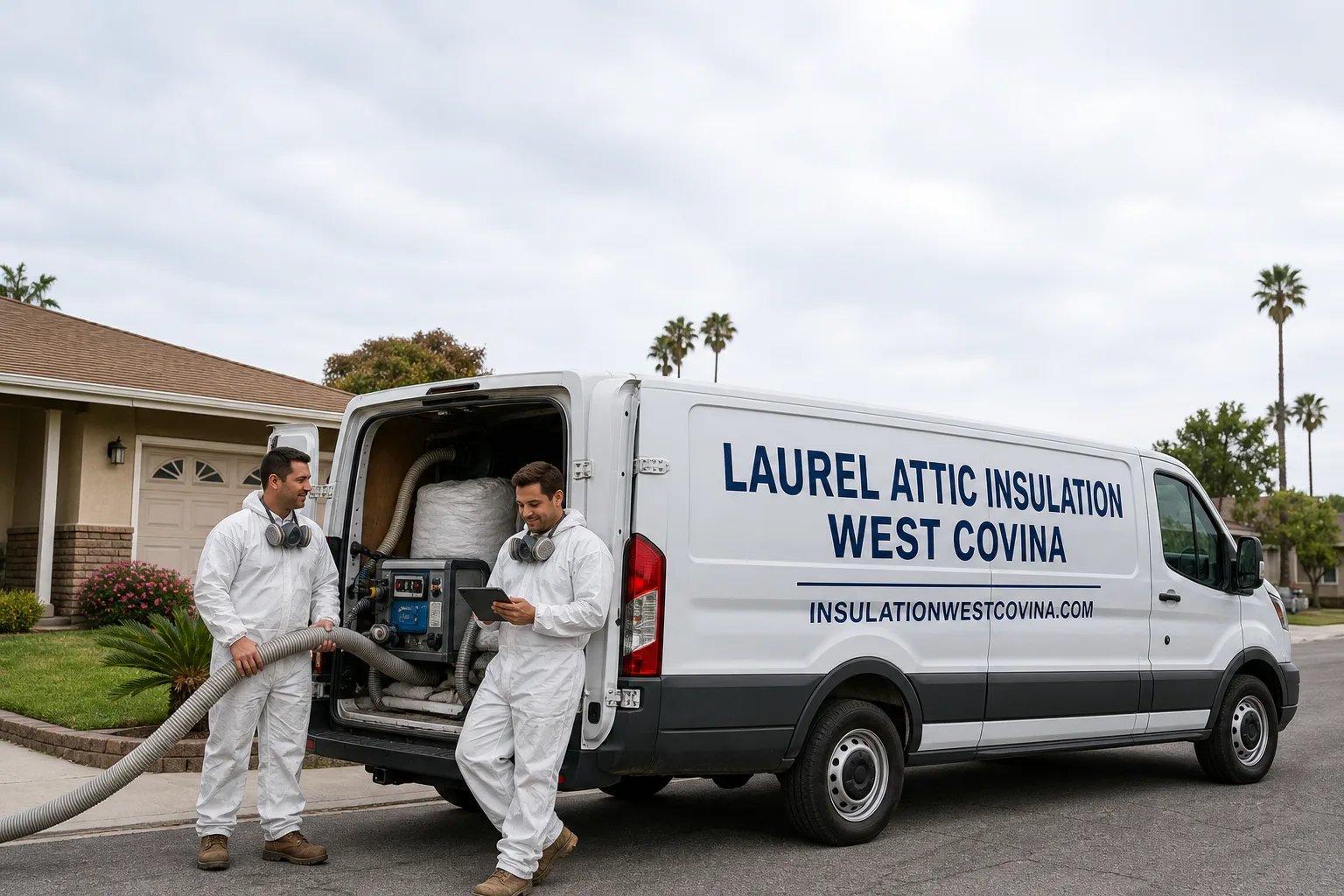
Fast, Reliable Attic Insulation Across San Dimas
Most attic insulation jobs in San Dimas run $900 to $2,400 depending on square footage, existing R-value, and whether we’re topping up or doing a full removal and replacement. If your upstairs rooms bake in July and the ceiling feels warm at 9 p.m., the fix is usually in the attic, not the thermostat. We dispatch crews into San Dimas daily from our Los Angeles coordination office, and we know the housing stock here: 1970s ranchers off Arrow Highway, 1980s two-stories near Lone Hill, hillside custom builds along San Dimas Canyon Road. Call (831) 531-5104 and you’ll get a live person, a written price before anything starts, and a trackable arrival time instead of a four-hour “window.”
Why Laurel Attic Insulation West Covina Is San Dimas’s Preferred Attic Insulation Company
San Dimas homeowners keep calling us back because we show up when we say we will and we put the price in writing first. That’s the Relay Visibility Guarantee, and it applies to every single job we run in San Dimas. You get live technician tracking, before-and-after photo proof, and a digital invoice you can pay from a link. No door-step surprises.
We’re part of the Relay Home Co. family, founded in 2003, and we’re led by Chase Whitaker. The name Laurel comes from the idea that laurel stays green all year, and so should your home’s comfort. That’s the guiding principle for every attic we touch in San Dimas.
Every job also carries the 365-Day Done Right Promise. If the insulation isn’t performing, we make it right within a full year, in writing. And if a repair fails, the second visit is free. That’s not a vague promise; those are the terms on your invoice.
Our technicians are background-checked, uniformed, and trained on the specific attic conditions we see in San Dimas, from settled 1980s fiberglass to ember-risk eave vents in Via Verde. We answer the phone 24/7, which matters when a Santa Ana wind event has you worried about what’s happening in your attic at 2 a.m.
Attic Ventilation in San Dimas
Attic Ventilation in San Dimas is the difference between an attic that stays 110 degrees in August and one that hits 140 degrees and radiates heat into your bedrooms all night. In San Dimas’s climate, with hot, dry summers and Santa Ana wind events that can push embers into eave vents, ventilation isn’t a nice-to-have. It’s foundational. A properly ventilated attic, typically using a mix of soffit intake vents and ridge or gable exhaust vents, keeps air moving so insulation can do its job and moisture never gets a chance to condense on roof sheathing.
We typically install or upgrade attic ventilation in San Dimas homes before or alongside new insulation, and the cost usually runs $350 to $900 depending on the number of vents and whether we’re adding baffles. On older homes, especially 1970s and 1980s ranchers with original eave vents that are painted shut or blocked by debris, ventilation upgrades alone can drop upstairs temperatures by several degrees in the first week.
Baffles and Airflow Prep
When we add insulation to a San Dimas attic, we install baffles at every eave vent to keep insulation from blocking airflow. Without them, even the best blown-in cellulose loses effectiveness because the soffit path gets choked. This prep is a small line item, usually $75 to $200 for most San Dimas attics, and it’s included when we do a full insulation replacement.
Ember-Resistant Vent Covers
For hillside homes along San Dimas Canyon and Via Verde, we recommend ember-resistant vent covers as part of any ventilation upgrade. These covers allow air to flow while stopping wind-driven embers from entering the attic, which is a real fire-defense consideration for that part of San Dimas. Most homeowners add these for $150 to $400 depending on vent count, and they’re worth every dollar when the Santa Anas kick up.
Radiant Barrier in San Dimas
Radiant Barrier in San Dimas is a reflective foil layer installed under the roof deck that bounces radiant heat back out before it ever penetrates your attic’s insulation. Given San Dimas’s intense summer sun, especially in west-facing homes near Cienega Avenue and the open exposures around the Bonita corridor, a radiant barrier can reduce attic temperatures by up to 30 degrees on a 100-degree day. That’s measured, field-observed performance, not a brochure number.
A radiant barrier install in San Dimas typically runs $1,200 to $2,800 depending on attic square footage and roofline complexity. It pairs well with blown-in insulation but it’s not a replacement for it, so we usually quote it as an add-on to an insulation job rather than a standalone service. In attics where ductwork runs through the hot zone, the payoff is faster: cooler air moving through AC ducts, less runtime, and a lower bill during San Dimas’s five hottest months.
Where We Install It
We staple radiant barrier to the underside of roof rafters, not directly onto the attic floor. That’s the correct placement for San Dimas homes, because it keeps the barrier’s reflective surface facing an air gap, which is what makes it work. Direct-on-floor installation is a common shortcut that kills performance, and it’s one of the first things we check when doing an attic audit.
Vaulted Ceiling Considerations
Hillside custom homes in San Dimas often have vaulted ceilings with little or no attic floor space, and that’s exactly where radiant barrier earns its place. Last June we re-insulated a 1980s rancher off San Dimas Canyon Road where the original Owens Corning fiberglass batts had settled to R-19 in a vaulted ceiling. Our crew removed the degraded batts, air-sealed the top plates, and blew in GreenFiber cellulose to R-38, cutting the homeowners’ cooling load by an estimated 22% during the next Santa Ana heat wave. Adding radiant barrier to that roofline would have pushed the number higher.
Trusted Brands We Service in San Dimas
We stock and install materials from Owens Corning, GreenFiber, Demilec, and Johns Manville, matched to the job rather than whatever happens to be on the truck. For San Dimas homeowners, that means you get the right product for your specific attic: fiberglass batts for easy-access flat attics, blown-in cellulose for irregular cavities in older homes, and spray foam for hillside builds where air sealing matters as much as R-value. We keep common replacement materials in local staging so most San Dimas jobs move from quote to install within the same week.
Common Attic Insulation Problems We See in San Dimas Homes
- Settled 1970s to 1990s fiberglass batts: Thirty years of gravity drops R-30 batts to R-19 or less, leaving ceiling drywall hot to the touch during summer afternoons. The insulation is still there; it just isn’t doing much. We see this constantly in the older subdivisions south of the 210 and around Lone Hill Avenue.
- Ember intrusion through open eave vents: Hillside homes near San Dimas Canyon and Via Verde face a wildfire risk most of the San Gabriel Valley never thinks about. Exposed kraft-faced batt insulation can ignite from wind-driven embers entering unguarded vents during Santa Ana events.
- Unsealed attic bypasses around recessed lights and plumbing chases: Superheated attic air gets pushed into living spaces through these gaps, spiking cooling bills in older Bonita Avenue adjacent homes. It’s an air-sealing problem, not an insulation problem, but it acts like missing insulation.
- Degraded rigid foam in older flat-roofed sections: Along Bonita Avenue, especially on converted residential buildings with flat or low-slope roofs, the original rigid foam insulation is often degraded by decades of UV exposure and thermal cycling. That leads to high cooling bills every summer and it needs full replacement, not a top-up.
Pricing for Attic Insulation in San Dimas, CA
We Also Serve Cities Near San Dimas
Our crews handle Attic Insulation work across the eastern San Gabriel Valley. Beyond San Dimas, we regularly cover Azusa, West Covina, La Puente, and Rowland Heights. If you’re in one of those cities and your attic needs attention, same booking process, same written pricing, same 365-Day Done Right Promise. You can see more about our local coverage on the Attic Insulation in San Dimas page.
Serving San Dimas, CA - Our Local Coverage Area
We’re based in the San Dimas area and know this community well. Use the map below to see our service coverage - if you’re nearby, we can almost certainly help.
FAQs About Attic Insulation in San Dimas
Does San Dimas’s wildfire risk require special attic insulation materials?
Yes, for hillside homes in Via Verde and along San Dimas Canyon, we recommend fire-resistant materials like Rockwool or fiberglass with ignition barriers, plus ember-resistant vent covers. These areas face a specific combination of diurnal temperature swings and ember intrusion risk that flatland San Dimas neighborhoods don’t share, and standard cellulose or kraft-faced batts without protection aren’t our default recommendation there. Call (831) 531-5104 and we’ll tell you straight what your specific attic needs.
How often should attic insulation be replaced in a 1980s San Dimas home?
If the insulation is original and has never been topped up, it’s past due. Fiberglass batts from the 1980s settle and lose loft, dropping from R-30 to R-19 or below, and they often harbor dust, pest debris, and moisture stains that reduce performance further. We generally recommend replacement rather than top-up when the original material is over 30 years old, and that’s the case for most 1980s San Dimas homes we audit. A free attic inspection gives you a definitive answer.
Can radiant barrier help with San Dimas’s intense summer attic heat?
Yes. Radiant barrier installed under the roof deck bounces radiant heat before it reaches the insulation, which can cut attic temperatures by up to 30 degrees during San Dimas’s hottest afternoons. It’s most effective on west-facing exposures and homes with ductwork running through the attic. It costs $1,200 to $2,800 for most San Dimas homes and works alongside, not instead of, proper insulation.
What’s the best attic insulation for homes near Bonita Avenue’s older flat-roofed sections?
For flat or low-slope roofs near Bonita Avenue, closed-cell spray foam like Demilec is usually the right call. It insulates and air-seals in one step, and it doesn’t settle or absorb moisture the way loose-fill does in a low-ventilation flat roof cavity. The original rigid foam in many of these buildings is UV-degraded and underperforming, so a spray foam retrofit typically cuts cooling bills noticeably the first summer.
Do I need to upgrade attic ventilation before adding insulation in San Dimas?
Not always, but in many San Dimas attics, yes. If your soffit vents are painted shut, blocked by old insulation, or there simply aren’t enough intake and exhaust points, adding insulation without fixing ventilation traps heat and moisture. We check ventilation as part of every attic audit and we’ll give you a straight answer: sometimes it’s a full vent upgrade, sometimes it’s just baffles to keep airflow clear. The cost ranges $350 to $900, and it’s factored into your written quote before anything starts.
Get Your San Dimas Attic Fixed on Your Schedule
You shouldn’t have to guess what’s wrong with your attic or what it’ll cost to fix. Call (831) 531-5104 and you’ll get a live person who can schedule an attic audit in San Dimas, explain what we find, and hand you a written price before a single staple is set. We’re the insulation specialists behind the Relay Visibility Guarantee: live arrival tracking, before-and-after photos, and a 365-Day Done Right Promise in writing on every job. Serve San Dimas, live comfortably, and stop paying to cool an attic that’s working against you.
Written by Chase Whitaker, Owner at Laurel Attic Insulation West Covina, serving San Dimas with attic insulation, ventilation, and radiant barrier work.